Take 01
Rain on leaves, made indoors
A wet afternoon outside is hard to record cleanly. A tray, a spray bottle and a pile of leaves get surprisingly close.
Real rain is a generous sound and a difficult recording. It falls on everything at once, so a microphone placed outside hears the gutters, the road, the neighbour's roof and the hiss of distant tyres along with the leaves you wanted. For a scene that needs one plant in one garden, building the sound indoors is usually faster and cleaner.
This is the oldest trick in the trade. Film sound editors have been replacing location sound with sounds performed in a quiet room for about a century, and the craft carries the name of one of its early practitioners. The history of Foley is worth a read for the ingenuity alone: celery for bones, cornstarch for snow, a pair of gloves for wings.
The tray
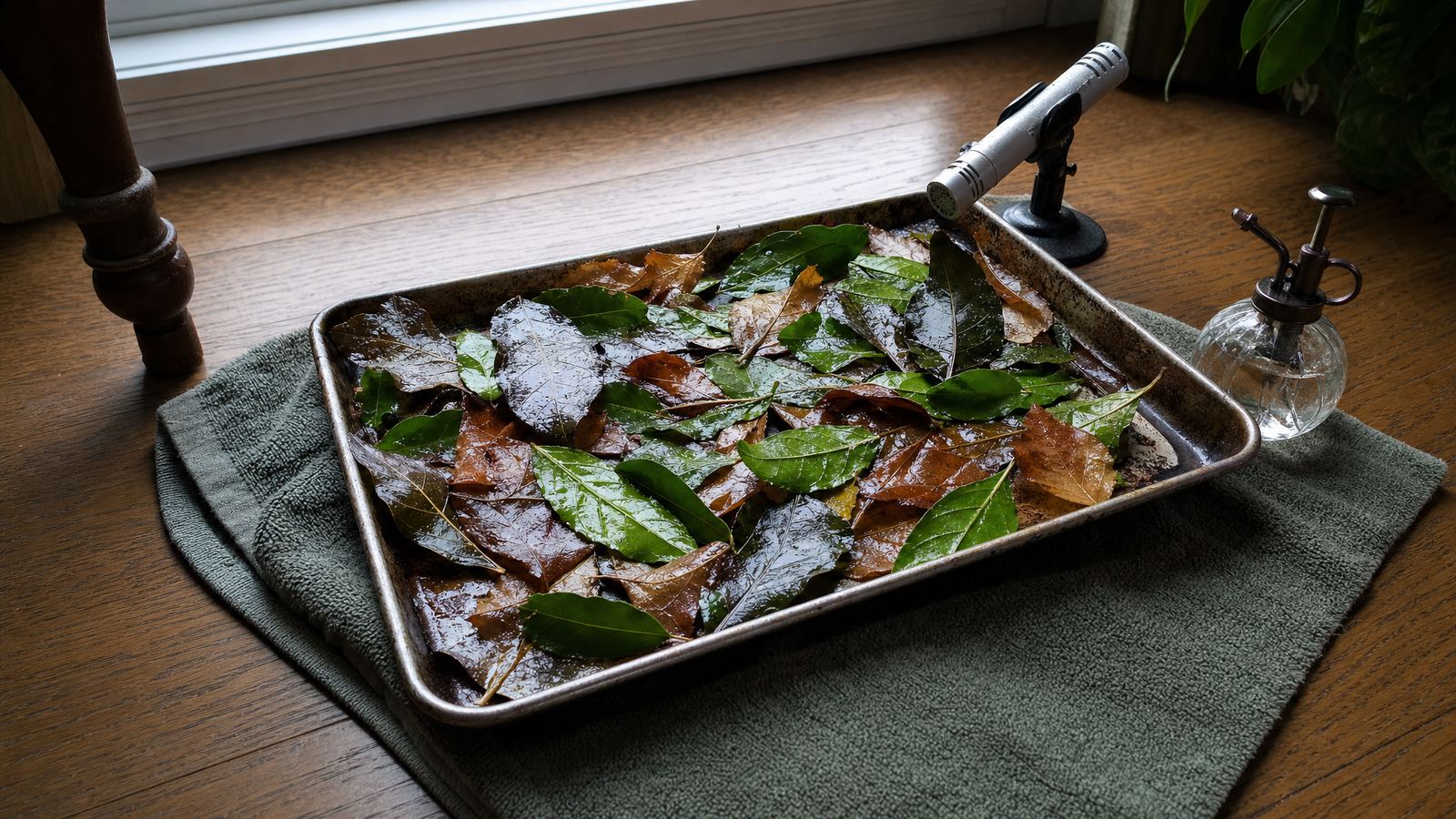
Use a baking tray or a shallow plastic storage lid, something wide and flat with a lip. Fill it loosely with leaves. A mix works best: a few broad fresh leaves for the soft slap of a drop landing on something green, and a handful of half-dry ones for the brighter tick. Leaves picked the same morning keep their give for an afternoon. Dry leaves alone sound like autumn, which is fine if that is the scene.
Put a folded towel under the tray. Without it, every drop carries a faint ring from the metal and the floor joins in.
The drops
A plant mister set to a coarse spray gives a convincing light shower when held about a metre above the tray. For heavier rain, use a watering can with a rose head and pour slowly from shoulder height. Single fat drops, the kind that fall from a branch after the rain has stopped, come from a drinking straw: dip it, cover the top with a finger, and release over one leaf at a time.
Vary the rhythm by hand. Machines and steady pours sound like machines and steady pours. Real rain has gusts in it, so lean the mister in and out of the tray's edge as you go.
The microphone
Start with the microphone about forty centimetres from the tray, angled down at the far edge rather than the middle. Closer than that, each drop becomes a separate event and the sound turns into popcorn. Further away, the room starts to show. A small-diaphragm condenser is ideal, but the built-in pair on a portable recorder does a decent job if the gain is set low and the recorder sits on a towel of its own.
Record more than you think you need. Three minutes of steady rain, then a minute of it easing off, then two minutes of drips. The easing-off take is the one that gets used most, because scenes end and the sound has to end with them.
Other surfaces
The same rig records rain on other things with small changes. A sheet of thin cardboard propped over part of the tray gives rain on a tent or an awning. An upturned plastic tub in the middle gives the hollow patter of rain on a garden chair. For rain on a car roof, hold a baking sheet a little above the leaves and let the spray hit both. Record each surface as its own take, so they can be mixed to suit the scene.
Keep the room warm and dry the floor between takes. Water on a hard floor squeaks under shoes and chairs, and the towel under the tray will need changing after half an hour.
Cleaning it up
Listen back on headphones and mark the bad seconds: a bump of the bottle on the tray, a breath, a car outside. Cut them and crossfade the gaps over half a second or so. A gentle high-pass filter around 80 Hz removes the floor rumble without thinning the leaves. Resist reverb at this stage. The scene's own space will be added later, and rain that already has a room baked into it never sits right outdoors.
Layer it with a quiet outdoor ambience recorded on a dry day, and almost nobody will hear the kitchen.